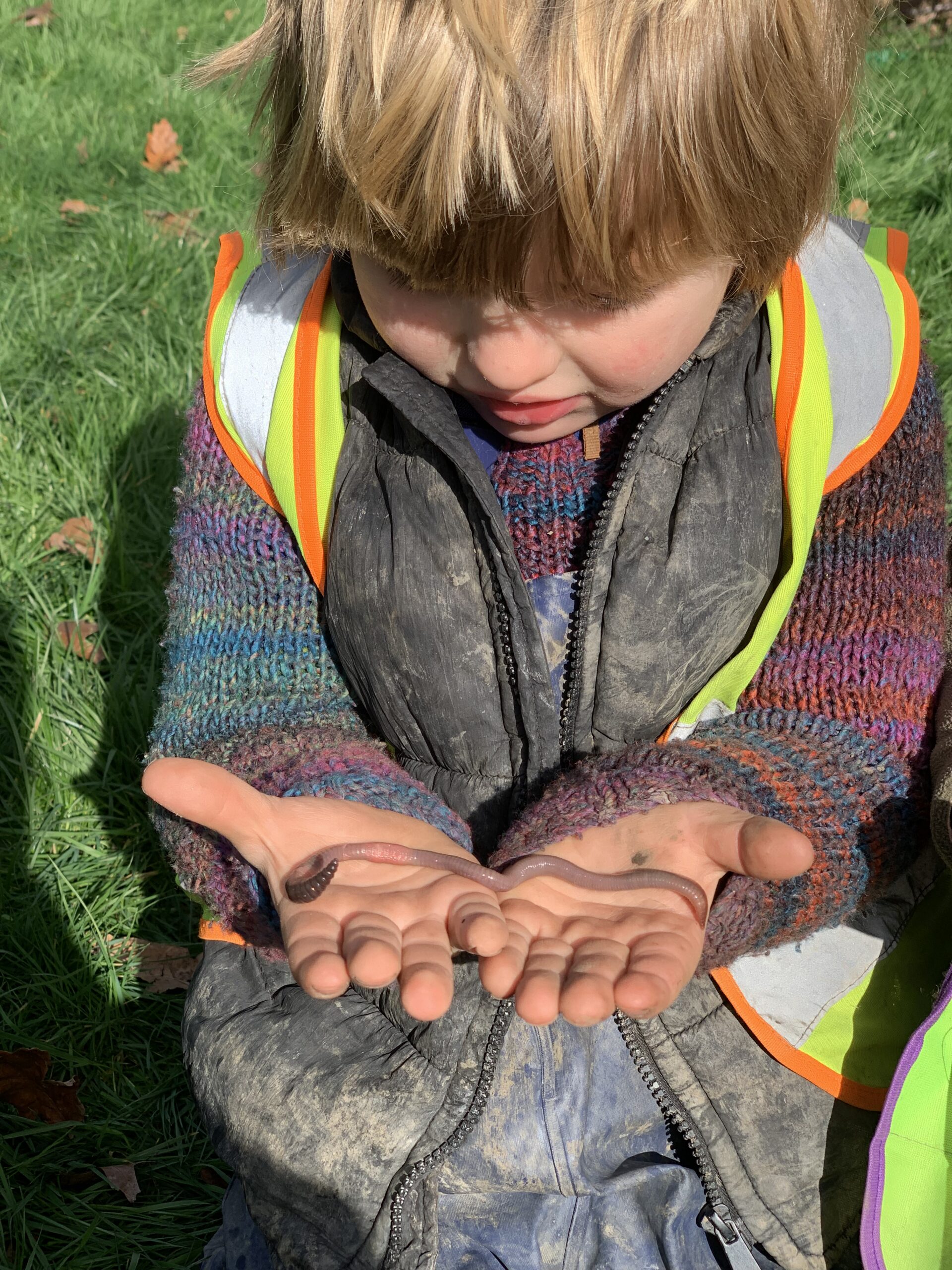
Curiosity is at the heart of every great learning adventure. Before children can know, they have to wonder.
When a child crouches to watch a worm curl, asks why the rain falls, or experiments with fitting a stick through a fence, they’re not being distracted, they’re investigating. They’re observing, testing ideas, and working out how the world works. That is scientific thinking in its earliest form.
At Growing Wild, we see curiosity as the engine that drives our curriculum. It fuels creativity, strengthens resilience, and gives real purpose to exploration. When adults protect space for questions rather than rushing to answers, we support children to think independently and deeply – key foundations for lifelong learning.
Curiosity links powerfully across all areas of development.
It strengthens communication and language as children describe what they notice: slippery, frozen, wobbly, rough. When they explain their ideas to friends, they are building vocabulary, confidence and narrative skills.
It supports physical development because investigating the world requires movement. Children stretch, climb, balance and crouch to get closer. Exploring uneven ground develops coordination and spatial awareness alongside problem-solving.
It builds personal, social and emotional development. When children feel safe enough to ask “why?” and share their theories, it shows trust. When adults respond with genuine interest, children learn that not knowing is okay and that builds confidence and emotional security.
Curiosity is also the root of early mathematical thinking. Comparing stick lengths, counting found treasures, noticing patterns in leaves, exploring capacity in puddles these are real mathematical experiences embedded in play.
It gives meaning to literacy too. Children who have investigated something meaningful have something real to talk about, draw, map or write about. Curiosity gives communication a reason.
Researchers such as Todd Kashdan and Paul Silvia describe curiosity as the desire to explore new information or the motivation to find out more. Neuroscientist Matthias Gruber has shown that when we are curious, the brain becomes more receptive to learning. In simple terms, when children care about the question, they are more likely to remember the answer.
Outdoors, curiosity feels natural because the environment changes every day – frozen puddle appears; the wind shifts; an ant crosses your path. The world itself provides a rich, evolving curriculum.
This is where adult interaction matters most. Rather than directing or correcting too quickly, we stay close, observe carefully, and extend thinking with simple prompts:
“I wonder why that happened?”
“What do you notice?”
“What do you think might happen next?”
These moments reflect high-quality teaching, not through formal instruction, but through responsive, sustained shared thinking. They demonstrate intent, implementation and impact in action: a curriculum built on children’s natural drive to explore, delivered through skilled adult support, leading to confident, motivated learners.
In a world that often values tidy outcomes and quick answers, curiosity can look slow or messy. It doesn’t always produce something to measure or take home.
But it produces thinkers. Problem-solvers. Children who are comfortable asking questions and confident enough to seek answers.
So this week, slow down. Notice what captures a child’s attention. Instead of answering immediately, try asking:
“What do you think?”
Then follow their lead and watch how curiosity carries learning forward.
Further Reading
| Kashdan, T. & Silvia, P. (2009). Curiosity and Interest: The Benefits of Thriving on Novelty and Challenge. In Positive Psychology: Exploring the Best in People. Gruber, M. J., Gelman, B. D., & Ranganath, C. (2014). States of Curiosity Modulate Hippocampus-Dependent Learning via the Dopaminergic Circuit. Neuron, 84(2), 486–496. Whitebread, D. (2012). Development of Metacognition and Self-Regulated Learning in Young Children. |
Janet Packer, 11th March 2026